

Blogodocious ramblings of a landscape photographer living in Maine.
Spring Growth

Spruce Sapling and Freshly Fallen Snow.
Have a good spring and grow up everybody! I mean that in the tallest of ways.
Order Your Fresh Killed Goat Whole or Half

Haymarket Square, Boston- an older street snap that I think about now and then.
Todays photographer of the day: Mary Ellen Mark. Happy birthday Mary Ellen! 
from the Wikipedia: Mary Ellen Mark (born March 20, 1940) is an American photographer known for her photojournalism, portraiture, and advertising photography. She has had 16 collections of her work published and has been exhibited at galleries and museums worldwide. She has received numerous accolades, including three Robert F. Kennedy Journalism Awards and three fellowships from the National Endowment for the Arts. Mary Ellen Mark was born in suburban Philadelphia, Pennsylvania,[1] and began photographing with a Box Brownie camera at age nine. She attended Cheltenham High School,[1] where she was head cheerleader and exhibited a knack for painting and drawing. She received a BFA degree in painting and art history from the University of Pennsylvania in 1962, and a Masters Degree in photojournalismfrom that university's Annenberg School for Communication in 1964.[2] The following year, Mark received a Fulbright Scholarship to photograph in Turkey for a year.[2] While there, she also traveled to photograph England, Germany, Greece, Italy, and Spain.[3]
In 1966[1] or 1967,[3] she moved to New York City, where over the next several years she photographed Vietnam War demonstrations, the women's liberation movement, transvestite culture, and Times Square, developing a sensibility, according to one writer, "away from mainstream society and toward its more interesting, often troubled fringes".[3] As Mark explained in 1987, "I'm just interested in people on the edges. I feel an affinity for people who haven't had the best breaks in society. What I want to do more than anything is acknowledge their existence".
Photography career
Mark became a unit photographer on movie sets, shooting production stills for films including Arthur Penn's Alice's Restaurant (1969), Mike Nichols' Catch-22 (1970), Carnal Knowledge (1971) and Francis Ford Coppola's Apocalypse Now (1979) among her earliest. For Look magazine, she photographed Federico Fellini shooting his film Satyricon (1969).[3] Mark has since photographed on the sets of more than 100 movies, up through at least director Baz Luhrmann's Australia (2008).[6] Mark is well known for establishing strong relationships with her subjects, as she has spoken about after her experiences in the Home for the Dying in Calcutta, and her project "Street Kids" for LIFE Magazine, which developed into the movie Streetwise.[7]
Mark has published 17 books of photographs; contributed to publications including Life, Rolling Stone, The New Yorker, and Vanity Fair; and her photographs have been exhibited worldwide.[2] She has served as a guest juror for photography call for entries at The Center for Fine Art Photography.


Mary Ellen Mark by Anestis Diakopoulos
and here's a good article here that differentiates here from Diane Arbus well: http://fadedandblurred.com/spotlight/from-the-edges-mary-ellen-mark/
Here's to you Mary Ellen!
Miniature Clay Figure Salutation at Sand Beach in Acadia

Miniature Clay Figure Salutation at Sand Beach in Acadia
This image did not go easy- because of that it will probably never be "one of my favorites". But there's still enough there for me to like to want to do everything in my power to make it presentable. If you're interested these were my problems: first thing is that it's a 3 shot "shift-pan" made with my 24mm tilt-shift, often it's worth it to make a "shift-pan" of a scene where you shift the lens through it's movements to get the widest aspect of the scene possible, also it makes a big file with lot's of resolution. Here though the problem was that because of the ultra straight horizon line my Manfrotto tripod ball head failed me and introduced just about a 1.5 pixel droop at the edges of the stitch so Photoshop CS5 kept coughing up errors at me when putting stitching the pan together. That was about a month ago, the other day I decided to go at it again and this time I opened it with PTGui, a dedicated panorama application that I used to use all the time when I was stuck in my panorama period back around 2005- 07. I had to download it from the web because I had never installed it on this machine and it wanted me to purchase the new version because my license was from pre 2010, but that didn't fear me and the old version worked a treat and resolved the horizon errors fairly perfectly. The rest I was able to handle with PS. That was just the beginning of the chase though. Because it was a long exposure the highlights of the wave action needed blending and attenuating, there were some vignetting issues to deal with in the corners from the shifting, and then explore, I spent a fair amount of time adjusting the presence of the water because at first it was a bit too lively and distracting. The thing is, which I mentioned yesterday, once the initial image started coming to life the hours just faded away while I was working on it. That's my ideal when working on images, when it becomes like a ride that you can't get off, fun stuff. But the truth is I'd much rather take 30 minutes at it and feel that it's done and can't be done anymore than it's done now.
Now I gotta get back to enjoying the snowstorm, have a good one! -Nate!
Spring Thaw Ice Fog Maine

Spring Thaw Ice Fog Maine. Mount Desert Island, Acadia National Park.
First thing is: I feel so guilty that I didn't make a post on Friday- been trying to keep a regular 5 days a week schedule here that has been a fun little motivator to make new photos or scour the catalog and develop something that was passed over earlier. Every day at 5:00 I make time to work on photography, or something like that- yesterday I worked on a photo all day long: I love it when developing becomes like reading a great novel- when hours evaporate and you feel like you've got miles to go but like you're still just getting your second wind. But that was an image that wasn't ever going easy- one that made me work for it, not this one, I'm just getting sidetracked. Just saying- I love it when that happens. Have a good one my friends- Nate!
Happy birthday Diane Arbus
Here's today's p.o.t.d. that has absolutely nothing to do with anything, other then this is pretty much what it looks like around here these days, minus all the mud: 
Tree, cracked road, clouds. Maine in the early spring.
Today is the anniversary of Diane Arbus's Birthday so we, us photographers, should all visualize giving a hearty high-five to the spirit of her.
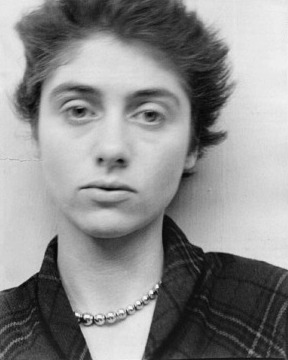
Diane Arbus by Alan Arbus, 1949
From the wikipedia: Diane Arbus (March 14, 1923 – July 26, 1971) was an American photographer and writer noted for black-and-white square photographs of "deviant and marginal people (dwarfs, giants, transgender people, nudists, circus performers) or of people whose normality seems ugly or surreal.".[2] Arbus believed that a camera could be “a little bit cold, a little bit harsh” but its scrutiny revealed the truth; the difference between what people wanted others to see and what they really did see – the flaws. A friend said that Arbus said that she was "afraid . . . that she would be known simply as 'the photographer of freaks'"; however, that phrase has been used repeatedly to describe her. Although some of Arbus's photographs have sold for hundreds of thousands of dollars at auction, Arbus's work has provoked controversy; for example, Norman Mailer was quoted in 1971 as saying "Giving a camera to Diane Arbus is like putting a live grenade in the hands of a child." Others have, however, pointed out that Mailer was dissatisfied with a picture of him holding his crotch taken by Arbus that was taken for the New York Times Book Review
.Arbus was born as Diane Nemerov to David Nemerov and Gertrude Russek Nemerov. The Nemerovs were a Jewish couple who lived in New York City and owned Russek's, a famous Fifth Avenue department store. Because of her family's wealth, Arbus was insulated from the effects of the [Great Depression] while growing up in the 1930s. Arbus's father became a painter after retiring from Russek's; her younger sister would become a sculptor and designer; and her older brother, Howard Nemerov, would later become United States Poet Laureate, and the father of the Americanist art historian Alexander Nemerov. In 1941, at the age of eighteen, she married her childhood sweetheart Allan Arbus. Their first daughter Doon (who would later become a writer), was born in 1945 and their second daughter Amy (who would later become a photographer), was born in 1954. Diane and Allan Arbus separated in 1958, and they were divorced in 1969.
Photographic career
The Arbuses' interests in photography led them, in 1941, to visit the gallery of Alfred Stieglitz, and learn about the photographers Mathew Brady, Timothy O'Sullivan, Paul Strand, Bill Brandt, and Eugène Atget.[1]:129[16] In the early 1940s, Diane's father employed them to take photographs for the department store's advertisements.[5] Allan was a photographer for the U.S. Army Signal Corps in World War Two.[16]
In 1946, after the war, the Arbuses began a commercial photography business called "Diane & Allan Arbus," with Diane as art director and Allan as the photographer.[5] They contributed to Glamour, Seventeen, Vogue, Harper's Bazaar, and other magazines even though "they both hated the fashion world."[10][17] Despite over 200 pages of their fashion editorial in Glamour, and over 80 pages in Vogue, the Arbuses' fashion photography has been described as of "middling quality."[18] Edward Steichen's noted 1955 photographic exhibit, The Family of Man, did include a photograph by the Arbuses of a father and son reading a newspaper.[6]
In 1956, Diane Arbus quit the commercial photography business.[5] Although earlier she had studied photography with Berenice Abbott, her studies with Lisette Model, beginning in 1956, led to Arbus's most well-known methods and style.[5] She began photographing on assignment for magazines such as Esquire, Harper's Bazaar, and The Sunday Times Magazine in 1959.[6] Around 1962, Arbus switched from a 35 mm Nikon camera which produced grainy rectangular images to a twin-lens reflex Rolleiflex camera which produced more detailed square images.[6][19][20]
In 1963, Arbus was awarded a Guggenheim Fellowship for a project on "American rites, manners, and customs"; the fellowship was renewed in 1966.[8][21] In 1964, Arbus began using a twin-lens reflex Mamiya camera with flash in addition to the Rolleiflex.[19] Her methods included establishing a strong personal relationship with her subjects and re-photographing some of them over many years.[6][10]
During the 1960s, she taught photography at the Parsons School of Design and the Cooper Union in New York City, and the Rhode Island School of Design in Providence, Rhode Island.[14][22] The first major exhibition of her photographs occurred at the Museum of Modern Art in a 1967 show called "New Documents," curated by John Szarkowski. The show also featured the work of Garry Winogrand and Lee Friedlander.[11] Some of her artistic work was done on assignment.[11] Although she continued to photograph on assignment (e.g., in 1968 she shot documentary photographs of poor sharecroppers in rural South Carolina for Esquire magazine), in general her magazine assignments decreased as her fame as an artist increased.[6][23] Szarkowski hired Arbus in 1970 to research an exhibition on photojournalism called "From the Picture Press"; it included many photographs by Weegee whose work Arbus admired.[14][16][24]
Using softer light than in her previous photography, she took a series of photographs in her later years of people with intellectual disability showing a range of emotions.[11][25] At first, Arbus considered these photographs to be "lyric and tender and pretty," but by June, 1971, she told Lisette Model that she hated them.[19]
Associating with other contemporary photographers such as Robert Frank and Saul Leiter, Arbus helped form what Jane Livingston has termed The New York School of photographers during the 1940s and 1950s. Among other photographers and artists she befriended during her career, she was close to photographer Richard Avedon; he was approximately the same age, his family had also run a Fifth Avenue department store, and many of his photographs were also characterized as detailed frontal poses.[10][19][26] Another good friend was Marvin Israel, an artist, graphic designer, and art director whom Arbus met in 1959.[1]:144[26]
Death
Arbus experienced "depressive episodes" during her life similar to those experienced by her mother, and the episodes may have been made worse by symptoms of hepatitis.[6] Arbus wrote in 1968, "I go up and down a lot," and her ex-husband noted that she had "violent changes of mood."[5] On July 26, 1971, while living at Westbeth Artists Community in New York City, Arbus took her own life by ingesting barbiturates and slashing her wrists with a razor.[5] Marvin Israel found her body in the bathtub two days later; she was 48 years old.[5][6]
http://en.wikipedia.org/wiki/Diane_Arbus
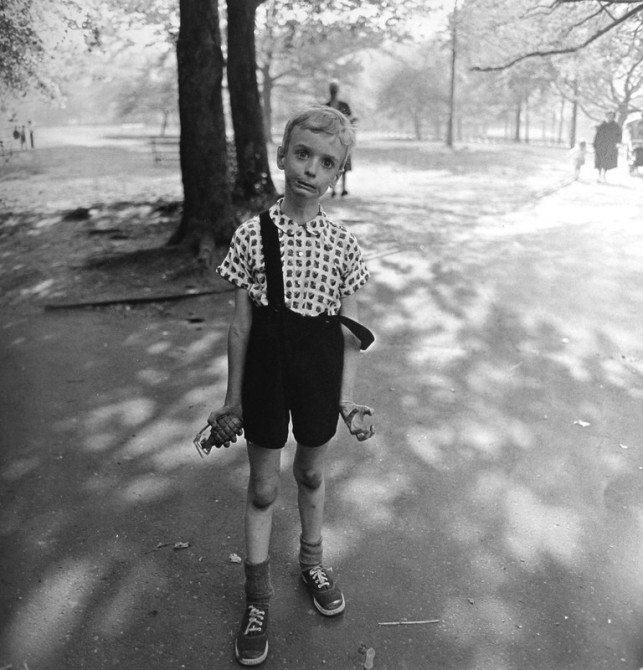
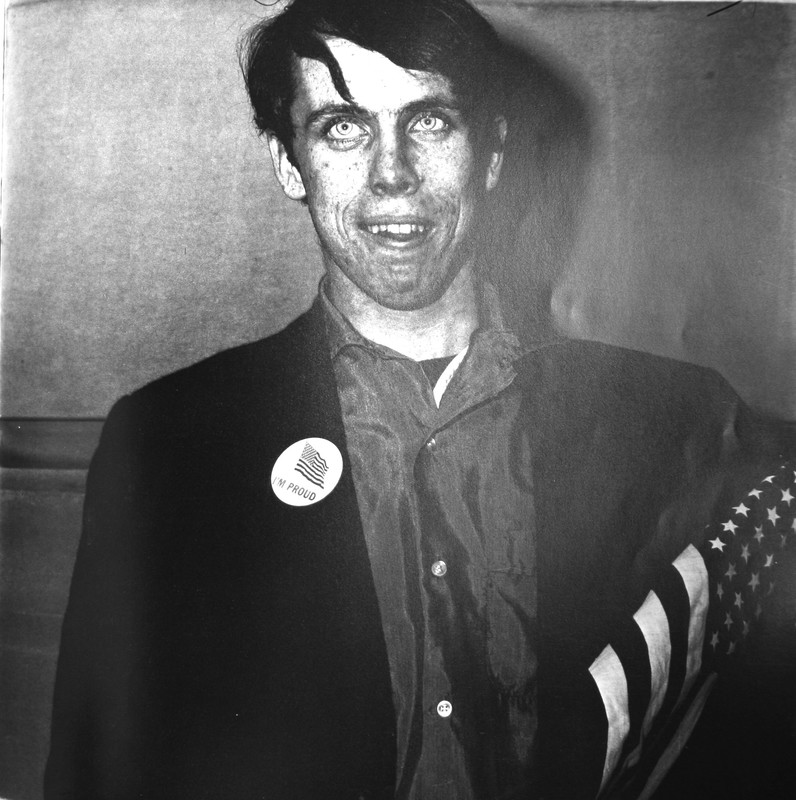


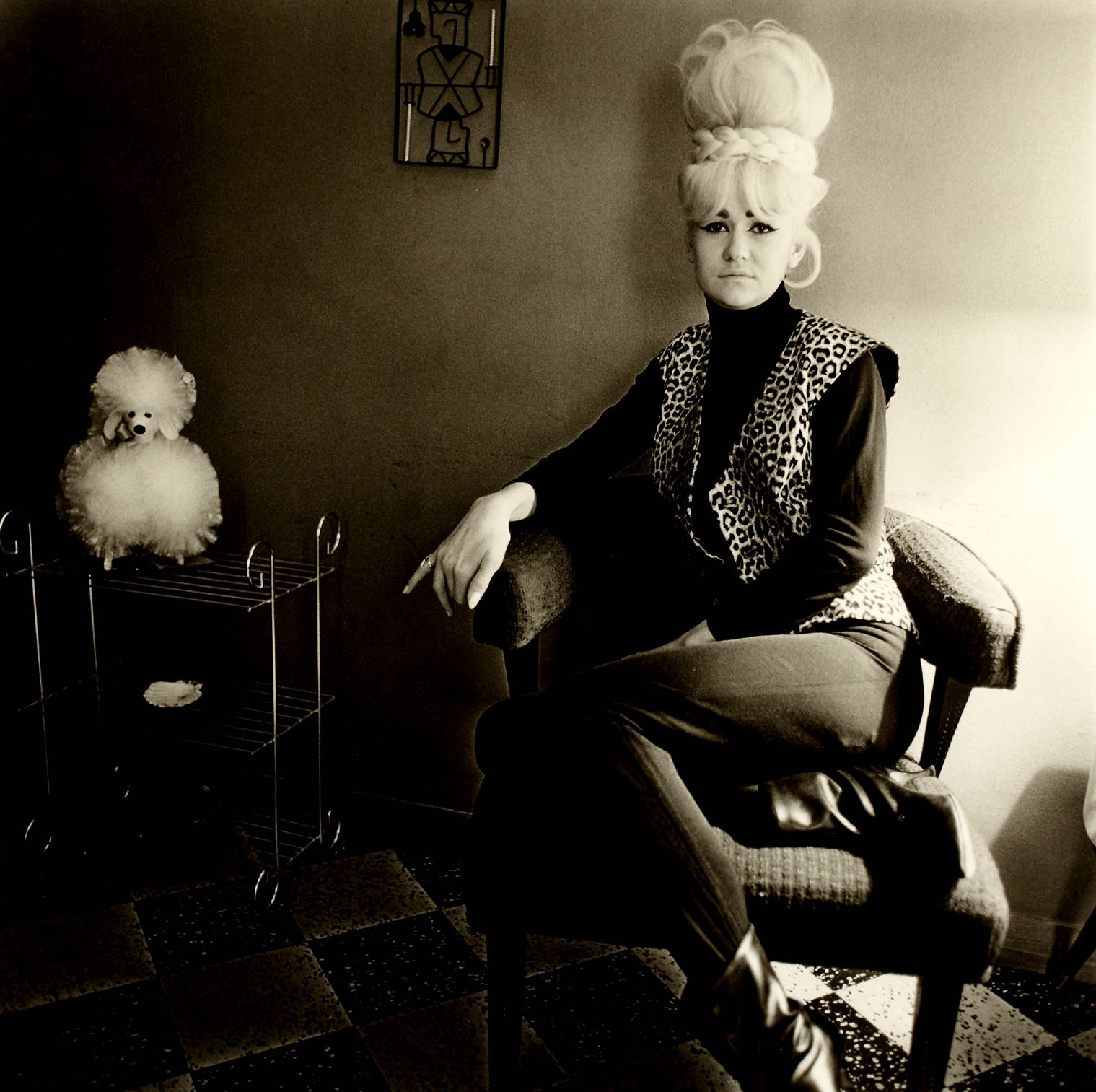


Here's to you Diane-
